Decentralized Care Across Multiple Settings: Perception vs. Research
Share

Decentralized care team stations have been a key feature in healthcare design for decades, originating in intensive care units and expanding into a variety of care environments. Despite its widespread use, research on the impact of decentralized care stations remains inconclusive.
Ballinger Senior Principal Louis A. Meilink, Jr., FAIA, FACHA, ACHE and Director of Healthcare Planning Fernanda Pires, EDAC, Lean Green Belt explored the topic of decentralized care stations at this year’s Healthcare Design Conference in Kansas City, MO. The presentation was developed in collaboration with University of Kansas PhD candidate Marzia Chowdhury, and sought to bridge the gap between research and practice through built examples.
The session paired a systematic literature review, covering studies from 2007 to 2024, with Ballinger’s significant project experience to test common perceptions against evidence. Using PRISMA methods, the team reviewed 58 peer-reviewed articles and synthesized the 30 most relevant.
Across the literature, decentralized stations are consistently linked to more patient-centered care: stronger caregiver-to-patient communication, improved patient satisfaction, and reduced medication errors. However, the research also shows tradeoffs: social interaction and staff cohesion can weaken when caregivers are spread out, and findings on efficiency and walking distance are mixed, often driven less by the stations themselves and more by broader unit planning, staffing ratios, and the location of support spaces. In other words, successful decentralization depends on the full care delivery model and unit design, not a single workstation decision.

Research Findings
The presentation mapped these insights to specific applications – patient care units, diagnostic and treatment, and oncology – showing that hybrid models are frequently the best fit, combining bedside proximity with shared team hubs. This was supported by polling data collected from the presentation audience, which revealed the diversity of approaches currently in use and the value of a hybrid approach. The key takeaway: there is no one-size-fits-all approach.

Unit Design Layout Definitions
To guide healthcare systems toward the right solution, Ballinger recommends a process that incorporates research, observation, prototyping, and sharing of results. In addition, it is essential that the decision to implement a decentralized care model is accompanied by leadership support, training, and time to ensure it is adopted.
Building on the research completed to date, Ballinger is developing an expanded research plan and a practical toolkit to help project teams tailor decentralized care strategies to each institution’s culture, service lines, and goals.
Tagged
Share
related insights
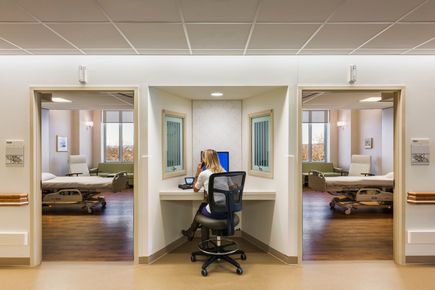
Evaluating the Benefits of Decentralized Stations Beyond Patient Visibility
- Resources|
- Planning|
- Healthcare|
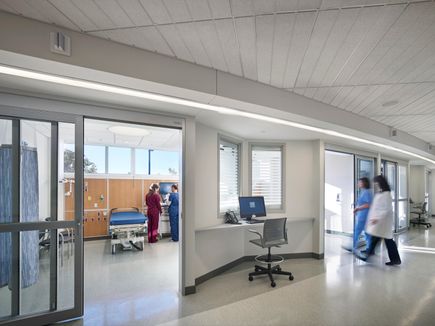
Ballinger to Present Research on Decentralized Care at Healthcare Design Conference
- Presentations|
- Architecture|
- Healthcare|

Fernanda Pires to Share Expertise at Healthcare Design Conference
- Events|
- Engineering|
- Healthcare|
Healthcare Design Q&A with Ballinger’s Louis Meilink
- Press|
- Architecture|
- Healthcare|


